






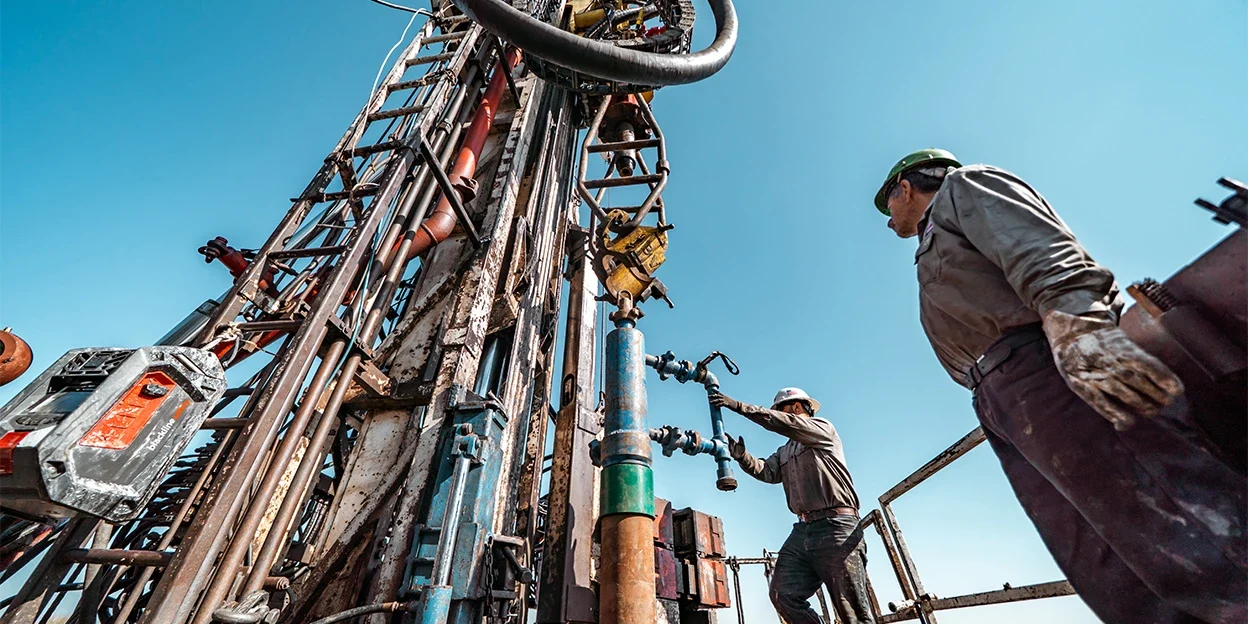
In almost 30 countries, energy prospectors are hunting for a potential game changer in the quest to fight global warming. Their quarry is hydrogen gas trapped deep underground in hidden deposits. They hope to find big reservoirs of this geological hydrogen — substantial enough that the gas could become a green replacement for fossil fuels.
When hydrogen is burned to produce electricity, the only by-product is water vapour — no carbon dioxide is emitted. And the potential for geologic hydrogen has energy specialists buzzing. Since 2023, venture capitalists have invested nearly US$500 million in the search for deposits.
A 2024 analysis suggests that Earth’s subsurface probably contains tens of trillions of tonnes of the gas1. If even a small fraction can be recovered at a profit, geologic hydrogen could meet projected clean energy needs for 200 years, potentially at, or even below, the cost of fossil fuels. “That’s why it has gathered momentum as quickly as it has,” says Owain Jackson, head of hydrogen-exploration company H2Au, headquartered in Epsom, UK, which started drilling in Kansas in August.
Or all of this could be a pipe dream. Nobody knows whether there are large enough deposits of geological hydrogen to match the hype. That’s why companies are racing to drill into the ground in many geological formations, from northern Canada to eastern Africa to South Australia. Findings from these wells could emerge within the next few months, providing key clues about the potential for geologic hydrogen.
“At the moment, we still don’t know if it’s almost nothing or completely everywhere,” says David Waltham, a geophysicist at Royal Holloway, University of London.
___
Unknown resource
All this excitement caught geologists by surprise. “On Wikipedia, natural hydrogen didn’t exist five years ago,” Jackson says.
Why didn’t hydrogen exploration begin decades ago? “Quite literally because everyone assumed it wasn’t there,” says Waltham.
That was true even for researchers studying hydrogen produced inside the Earth: the idea that the gas could accumulate underground to form large deposits never occurred to them, says geologist Chris Ballentine at the University of Oxford, UK.
The basic geochemistry of hydrogen production is well established2. The gas forms when iron-rich igneous rock, such as olivine, reacts with water. It can also be generated when α-particles, emitted by the radioactive decay of uranium or thorium, hit water molecules and split them. When hydrogen produced by these processes seeps through rock towards the surface, it can support subterranean microbial communities.
“I’ve been looking at the types of geological systems that produce natural hydrogen for quite some time — from the perspective of an energy source for microbes, not for society,” says Ballentine.
Researchers assumed that hydrogen produced underground wouldn’t accumulate in geological deposits that could be tapped.
“The Earth is a machine that produces huge volumes of hydrogen — but it is also a machine that destroys huge volumes of hydrogen,” says Eric Gaucher at Lavoisier H2 Geoconsult in Chamonix, France, who co-leads the natural-hydrogen taskforce at the International Energy Agency, based in Paris. That’s because microbes use the gas, and it is also consumed by geochemical reactions. Geologists assumed that any hydrogen that escapes that fate would leak through rock layers and disappear into the atmosphere, because the molecules are too small to become trapped underground, beneath impermeable rock layers.
Some geologists started to question that assumption in 2018. That’s when researchers published a report describing the discovery of a substantial hydrogen deposit in Mali3. “The first time it hit the scientific literature, it caught our attention,” Ballentine says. Geologists reasoned that bigger deposits of hydrogen could be out there, waiting to be found.
There is another line of evidence supporting this view: hydrogen can accumulate in deep mines — where it must be pumped out to avoid explosion. In 2024, for example, researchers found that at least 200 tonnes of hydrogen is released annually from a chromite mine in Albania, one of the biggest natural flow rates of hydrogen ever recorded